


Table of Contents
- Why Color Temperature Decides How Cozy a Room Feels
- The Kelvin Scale in Plain Numbers
- Warm White, Soft White and Cool White Compared
- The Best Kelvin for Living Room Comfort
- How to Layer Lighting for Ambiance in Every Room
- Dimmable Lighting Benefits for Evening Wind-Down
- Matching Color Temperature to Your Interior Style
- Common Color Temperature Mistakes to Avoid
- Frequently Asked Questions
Last Updated: September 11, 2026
Why Color Temperature Decides How Cozy a Room Feels
Color temperature is the measurement, in Kelvin, of how warm or cool a light source appears. Get it right and a room feels like a place you want to sink into; get it wrong and even beautiful furniture looks clinical. This guide breaks down how to choose lighting color temperature for cozy home interiors, room by room.
Coziness is not a single setting. It's a relationship between the Kelvin value of your bulbs, the layers of light in the room, and the time of day. A 2700K bulb in a poorly layered room still feels flat; a well-layered room with the wrong Kelvin feels cold.
The European Commission guidance on household lighting energy labels now rates bulbs on a clearer scale, which makes comparing warmth and efficiency easier than it used to be. But the label won't tell you whether a light feels inviting. That part is on you, and it's simpler than the jargon suggests.
Below: how to match Kelvin to each room, how layering transforms ambiance, and which mistakes kill the cozy factor.
The Kelvin Scale in Plain Numbers
The Kelvin scale runs from roughly 1800K to 6500K, and lower numbers mean warmer, more orange light, candlelight at the bottom, overcast daylight at the top (energy.gov). You only need the band that matters for home interiors.
- 1800K-2200K: Candle and firelight. Extremely warm, very orange.
- 2400K-2700K: Classic warm white. The cozy sweet spot for living spaces.
- 3000K-3500K: Soft white to neutral. Cleaner, slightly less golden.
- 4000K-5000K: Cool white. Crisp, alert, better for work.
- 5000K-6500K: Daylight. Bright and blue-toned.
For a home you want to feel warm, you'll live almost entirely in the 2200K-3000K range. Anything above 4000K in a lounge starts to read as an office.
Warm White, Soft White and Cool White Compared
The three labels on packaging map onto the Kelvin scale, but they overlap enough that the label alone isn't reliable: warm white sits around 2700K, soft white around 3000K, cool white from 4000K up.
| Label | Kelvin Range | Feel | Best Room |
|---|---|---|---|
| Warm white | 2200K-2700K | Golden, intimate | Living room, bedroom |
| Soft white | 2700K-3000K | Gentle, balanced | Dining room, hallway |
| Cool white | 3500K-4100K | Crisp, alert | Kitchen, bathroom, study |
| Daylight | 5000K-6500K | Bright, blue-toned | Utility, garage, task work |
The trap: two bulbs both labelled "warm white" can differ by 500K, and side by side the mismatch is obvious. Check the actual Kelvin number on the box, not just the marketing word.
The Best Kelvin for Living Room Comfort
The best Kelvin for living room comfort is 2700K, dimmable down toward 2200K in the evening, golden and relaxing without tipping into orange.
A fixed 2700K ceiling light handles the baseline; add a table or floor lamp at the same temperature for depth, avoiding the flat, single-source look that makes a room feel like a waiting area.
If your living room doubles as a home office, the fix is layering, not compromise: keep ambient light warm at 2700K and add a task light at 3000K-4000K only where you work. The two never need to match.
How to Layer Lighting for Ambiance in Every Room
Layering lighting means combining three light types, ambient, task, and accent, so a room has depth instead of a single flat source. It matters more than Kelvin alone: a 2700K bulb on its own reads flat, but the same bulb supported by two warmer, lower sources reads as golden.
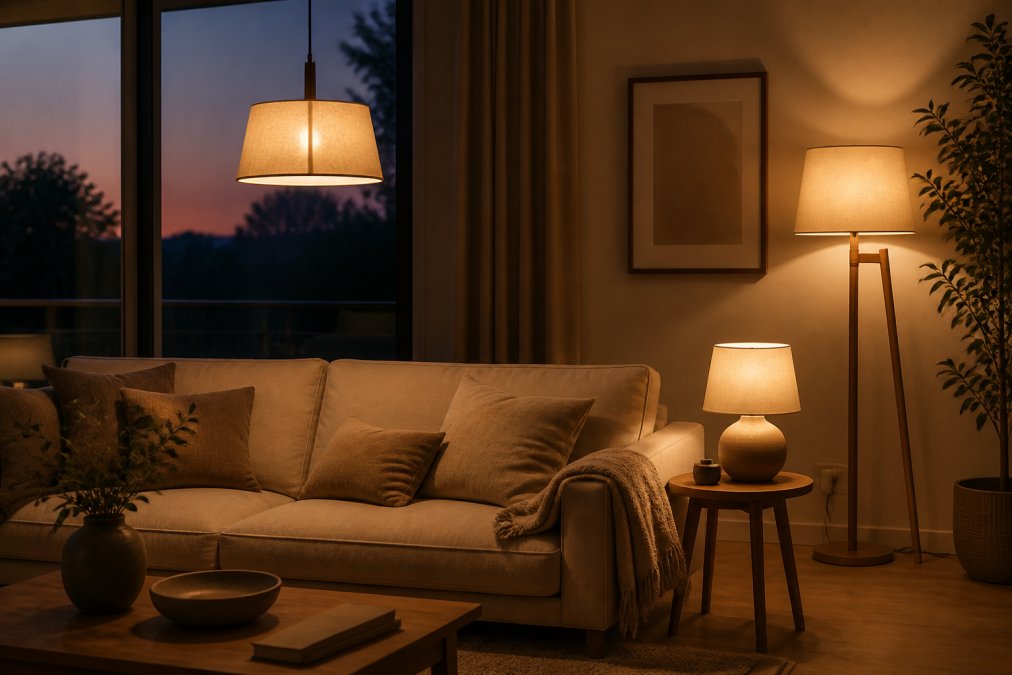
Ambient, Task and Accent Layers
- Ambient lighting is your base layer: a ceiling pendant or large overhead fixture. Keep it warm and dimmable, slightly dimmer than you think you need so other layers register.
- Task lighting is focused light for an activity: a reading lamp, desk light, or counter strip. It can run cooler, typically 3000K-4000K, because it serves focus rather than atmosphere.
- Accent lighting adds drama and warmth: a wall sconce, picture light, or corner lamp. This is where mood lives, and where you can drop to 2200K-2400K for the deepest golden effect.
A room with only ambient light feels institutional; all three layers feel intentional. For Japandi or Scandinavian interiors, aim for soft, low-contrast light with visible warm sources, letting accent and task layers do the emotional work.
Layering for Multi-Functional Rooms
Most homes combine living, working, and dining in one footprint, and a single Kelvin setting cannot serve all three. The fix is separation by layer and zone.
Keep the ambient layer fixed at 2700K across the room, then give each zone its own task layer:
- Desk or work corner: a 3500K-4000K task lamp on a separate switch, so it can be on while the ambient layer stays warm.
- Dining zone: a pendant or two at 2700K-3000K, ideally on a dimmer, so the table reads as its own warm pool.
- Reading chair: a floor lamp at 2700K, positioned so the light falls on the page and not into the eyes of anyone across the room.
With each layer on its own switch or dimmer, you transition the room by turning layers on and off rather than changing bulbs, cozy at 9pm, usable at 9am.
Timing the Layers to Your Evening
The sequence matters as much as the layers. Your body runs on a light-driven clock: bright, cool light in the evening says stay alert, warm dim light says prepare for rest.
A practical evening sequence most people find works:
- Early evening: ambient plus task, both at full brightness, so the room is functional.
- After dinner: drop the ambient layer to roughly half, keep the accent layer on, switch off the cool task light.
- Final hour before bed: ambient at its lowest warm setting, accent layer only, no cool light in the sightline.
You don't need smart bulbs, separate switches and dimmable fixtures are enough.
Dimmable Lighting Benefits for Evening Wind-Down
Dimmable lighting lets you lower both brightness and perceived warmth as the evening progresses. As light dims, most dimmable LEDs shift warmer, mimicking the sunset your circadian rhythm expects.
This is the psychological side of lighting most buying guides ignore, and the reason a single bright ceiling light at 10pm works against you.
The practical setup: choose dimmable fixtures for main living and bedroom lights, then drop them to their lowest warm setting an hour or two before bed. A simple dimmable fixture with a warm LED does the job.
Matching Color Temperature to Your Interior Style
Interior style and light temperature should reinforce each other: a warm palette wants warm light, while a cool, minimal palette can carry a slightly higher Kelvin without feeling harsh.
- Japandi and Scandinavian: 2400K-2700K. These styles rely on natural materials and soft contrast, so warm light deepens the wood and linen tones. A Nuits hanging lamp in a textile or natural shade, like the Lune Douce or Éclat Rotin, spreads that warmth evenly rather than in a harsh pool.
- Bohemian: 2200K-2700K. Layered, golden light suits the eclectic, textured feel.
- Modern minimal: 2700K-3000K. Slightly cleaner, still warm enough to feel lived-in.
- Industrial: 2700K-3000K. Warm light softens concrete and metal.
Paint color also changes how you perceive the same bulb: warm white on cool grey can look muddy, while on warm off-white it looks golden. Test a bulb against your actual wall before committing to a whole room.

Common Color Temperature Mistakes to Avoid
The most common mistakes come down to mixing temperatures carelessly, ignoring how a room is used, or treating light as purely visual when it also affects sleep. Avoid these and your home feels warmer immediately.
- Mixing Kelvin in one sightline. A 2700K lamp next to a 4000K bulb looks broken, not layered. Keep visible fixtures in a room within 300K of each other.
- Going too cool in living spaces. Anything above 3500K in a lounge reads as clinical, no matter how nice the furniture is.
- Trusting the label over the number. "Warm white" is not a fixed value. Read the Kelvin figure on the box.
- Forgetting CRI. A high color rendering index keeps colors true and makes warm light feel richer. Look for CRI 90 or above for living areas.
- Ignoring flicker. Cheap LEDs can flicker subtly, which undermines relaxation. Choose flicker-free drivers.
- Running cool light late into the evening. This is the mistake most guides skip. Bright, cool light in the final hours before bed works against your circadian rhythm, the internal clock that governs sleep. A 4000K ceiling light at 10pm tells your body it is still daytime.
The Circadian Mistake Most Guides Ignore
Color temperature is not only aesthetic. Your body uses light, especially the blue-rich end of the spectrum, to time alertness and sleepiness. Cool light in the morning supports waking; the same cool light late at night delays wind-down.
The practical rule: keep the brightest, coolest light to morning and early afternoon, and shift toward warm, dim light in the two hours before bed. For a cozy home, evening lighting should sit at 2200K-2700K and be dimmable, so brightness and perceived warmth both drop as the night goes on.
That's why a single bright ceiling light at 10pm works against you even if it's technically warm: brightness and Kelvin together determine the signal your body receives.
Budget-Friendly Smart Integration
You don't need a full smart-home system for tunable warmth. One smart dimmable bulb in your main evening lamp can provide the wind-down benefit.
A sensible starting order:
- One smart tunable bulb in the main evening lamp, so you can shift from 2700K to 2200K as the night progresses.
- A dimmable fixture for the ambient layer, so brightness can drop independently of Kelvin.
- A second smart bulb in the bedroom, set to a warm, low scene for the final hour.
Many smart bulbs now support a tunable white range from roughly 2200K to 4000K, covering both morning task and evening cozy settings from one fixture. Check the stated Kelvin range before buying, some budget bulbs only offer fixed warm white.
Frequently Asked Questions
Is 3000K or 4000K better for a living room?
For a living room, 3000K is usually the better choice. It sits at the warm end of the scale and gives the soft, golden light most people associate with a cozy home. A 4000K bulb is cooler and whiter, which works well in offices, garages and utility rooms but can make a lounge feel clinical in the evening. If you want to read or work in the same room, use a 3000K ceiling light and add a brighter task lamp rather than switching the whole room to 4000K.
What is the best color temperature for home lighting overall?
Most homes work best with 2700K to 3000K in living areas, bedrooms and dining rooms, because this range feels warm and inviting without turning yellow. Kitchens and bathrooms often benefit from 3000K to 4000K for clearer visibility at the counter or mirror. The trick is to keep one temperature per room so the light stays consistent, then adjust brightness with dimmers instead of changing Kelvin. That single rule prevents most mismatched lighting.
Can you mix different color temperatures in the same room?
You can, but only with a clear purpose. A common approach is a warm 2700K pendant for the dining table above and a slightly cooler 3000K floor lamp near a reading chair. The wider the gap, the more obvious the clash becomes, so stay within 300 to 500K between fixtures in one space. Keep one temperature per layer, and always check the Kelvin rating on the box before you buy, since two bulbs that look identical can differ by 1000K.
How does color temperature affect the mood of a room?
Color temperature changes how a room feels more than almost any other lighting choice. Warm light around 2200K to 2700K makes a space feel intimate and relaxed, which suits bedrooms and evening lounging. Neutral light near 3000K keeps things friendly but focused, good for dining and kitchens. Cooler light from 4000K upward feels crisp and alert, which is why it belongs in workspaces. Choose the mood first, then match the Kelvin number to it.

