


Table of Contents
- Quick Start: The 5-Step Scandi-Boho Lighting Mix
- Step 1: Pick a neutral base with one organic accent
- Step 2: Layer ambient, task, and accent light
- Step 3: Set color temperature to 2700K
- Best Materials for Bohemian Lighting (and How to Pair Them with Scandi Clean Lines)
- How to Layer Lighting in a Living Room for a Scandi-Boho Feel
- Choosing Pendant Lights for Scandi-Boho Style
- Balancing Minimalist Scandi Fixtures with Eclectic Boho Accents
- Smart Lighting and Dimmable Solutions for Scandi-Boho Homes
- Common Mistakes to Avoid When Mixing Scandinavian and Bohemian Lighting
- Frequently Asked Questions
Last Updated: September 24, 2026
Quick Start: The 5-Step Scandi-Boho Lighting Mix
Learning how to mix scandinavian and bohemian lighting styles starts with pairing a calm, neutral base with warm organic accents, then layering three light sources at one consistent color temperature. The result feels clean but lived-in, never cold and never cluttered.
The trick is knowing which style leads. Scandinavian design sets the bones: clean lines, a neutral palette, plenty of light. Bohemian style adds the soul: rattan, soft textiles, a warm glow.
Here is the five-step version you can start tonight.
- Pick a neutral base. Choose white, cream, or soft grey as your main tone.
- Add one organic accent. Rattan, wicker, or bamboo brings warmth.
- Layer your lighting. Combine ambient, task, and accent sources.
- Set color temperature to 2700K. This is the sweet spot for cozy light.
- Repeat materials twice. Two wood tones or two natural textures tie the room together.
Step 1: Pick a neutral base with one organic accent
Start with a neutral palette, then introduce exactly one organic shape or material. This keeps minimalism from feeling sterile while stopping bohemian style from taking over.
A common mistake is adding three or four organic pieces at once. The room turns busy fast. One rattan pendant or one bamboo floor lamp is enough to shift the mood.

Pair a clean-lined fixture with a natural-material one. The contrast is what makes Scandi-Boho work. Soft stripes, earthy tones, and monochromatic walls give the accent room to breathe.
- Walls and ceiling: white, cream, or warm grey
- Main furniture: light wood, linen, wool
- One accent: rattan, wicker, or bamboo
- Textiles: one textured throw, one patterned cushion
Step 2: Layer ambient, task, and accent light
Every Scandi-Boho room needs three light layers working together. Skipping a layer leaves the room flat.
Ambient lighting is your base: a pendant or ceiling fixture that fills the room with an even wash. Task lighting handles reading and working, usually a floor or table lamp. Accent lighting adds the glow: a small lamp on a shelf, a candle, or a low-watt bulb behind a plant.

Aim for three to five light sources in a living room.
Step 3: Set color temperature to 2700K
Set every bulb in the room to 2700K and the space feels warmer within minutes. Color temperature is measured in Kelvin, and 2700K sits in the warm, golden range.
Here is what the numbers mean in practice:
| Color Temperature | Feel | Best Room |
|---|---|---|
| 2200K | Candle-like, very warm | Bedside, dining |
| 2700K | Warm glow, cozy | Living room, bedroom |
| 3000K | Neutral white | Kitchen, bathroom |
| 4000K+ | Cool white | Workspace, garage |
Best Materials for Bohemian Lighting (and How to Pair Them with Scandi Clean Lines)
The best materials for bohemian lighting are rattan, wicker, bamboo, linen, ceramic, and natural wood, each paired with a simple, clean-lined Scandi fixture. Natural materials bring texture and warmth; clean lines keep the result from tipping into clutter.
- Rattan + slim metal: open texture, clean silhouette
- Bamboo + canvas: soft, zen, relaxed
- Ceramic + linen: rustic base, soft shade
- Walnut + stone: warm accent, cool structure
How to Layer Lighting in a Living Room for a Scandi-Boho Feel
Layering lighting in a living room starts with one ambient source, then adds task and accent lights at different heights. The goal is soft light at eye level and below, not a bright ceiling wash.
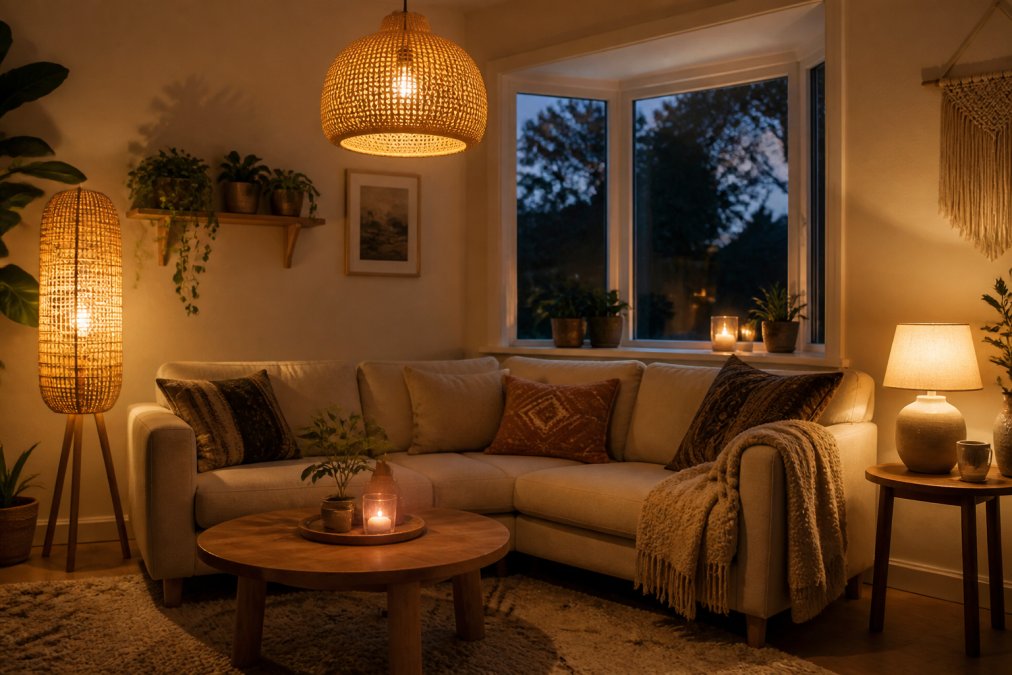
- Ceiling or pendant: your ambient layer, dimmed in the evening
- Floor lamp in a corner: task light for reading
- Table lamp on a side table: accent glow near the sofa
- Small lamp or candles on a shelf: low-level warmth
Choosing Pendant Lights for Scandi-Boho Style
Choosing pendant lights for Scandi-Boho style comes down to shape, material, and three specs most guides ignore: beam angle, dimming compatibility, and glare control. Get those right and a simple silhouette in a natural material does the rest.
Height guidance:
- Over a dining table: 75 to 85 cm above the tabletop
- Over a kitchen island: 80 to 90 cm above the counter
- In a hallway or bedroom: 200 to 210 cm from the floor
Balancing Minimalist Scandi Fixtures with Eclectic Boho Accents
Knowing how to mix scandinavian and bohemian lighting styles means letting one style dominate and the other accent it. Keep fixtures minimal and let textiles, plants, and small objects carry the bohemian spirit.
Smart Lighting and Dimmable Solutions for Scandi-Boho Homes
Smart bulbs and dimmable fixtures solve the biggest Scandi-Boho problem: one room, many moods. Run bright, neutral light for daytime and drop to a warm glow at night without changing a single bulb.
- Smart bulbs: no wiring, full color-temperature control, but each bulb needs its own app or hub and they can be expensive per fitting.
- Smart plugs with a dumb dimmable lamp: the cheapest way to automate an existing table or floor lamp, but you only get on/off and brightness, not color temperature.
- Smart switches or a hub: control a whole circuit from one place, best when you have many fixtures, but it usually needs an electrician and a neutral wire at the switch.
Room-specific plans beat one blanket rule:
-
Living room: ambient pendant on a dimmer, plus two smart lamps set to warm after sunset. Run the pendant at roughly 30% in the evening and let the lamps carry the room.
-
Bedroom: a tunable bulb that starts neutral for getting ready and drops to a candle-like low end for winding down. A sunrise-style fade-in is gentler than a sudden alarm.
-
Home office: keep this one cooler and brighter during work hours, around 3000K to 4000K, then warm it in the evening so the room does not feel clinical after hours.
-
Hallway and stairs: motion sensors on a short timer are practical and keep the Scandi-Boho look uncluttered, because no one has to reach for a switch.
-
Smart bulbs: no wiring, full color temperature control
-
Plug-in dimmers: cheap, removable, works with any lamp
-
Motion sensors: handy for hallways and stairs
-
App schedules: warm light after sunset, automatically
Common Mistakes to Avoid When Mixing Scandinavian and Bohemian Lighting
Most Scandi-Boho lighting fails for one of five reasons, and all five are easy to fix. Check your room against this list before you buy.
| Mistake | Why It Fails | The Fix |
|---|---|---|
| Mixed color temperatures | Clashes, feels cold | Set every bulb to 2700K |
| One bright ceiling light | Flattens textures | Add 2-3 lamps |
| Too many organic pieces | Room feels busy | Limit to one accent per zone |
| All lights at one height | Looks flat | Vary height and size |
| Cool white bulbs | Kills the warm glow | Switch to warm white |
Frequently Asked Questions
What are the key differences between bohemian and Scandinavian lighting styles?
Scandinavian lighting favors clean lines, neutral tones, and functional design with minimal ornamentation. Bohemian lighting leans toward eclectic, layered pieces with organic shapes, rattan, wicker, and warm, textural elements. The two styles meet in their shared love of natural materials and warm glow. Mixing them means using Scandi restraint as your base and adding boho accents like a rattan pendant or a linen-shaded table lamp for visual interest.
Which materials work best for a Scandi-Boho lighting scheme?
Natural materials bridge both styles: rattan, bamboo, linen, ceramic, stone, and walnut. Rattan and wicker add bohemian texture, while linen and stone keep the look clean and Scandinavian. For example, a rattan pendant light brings organic warmth without clutter, and a stone-and-walnut fixture adds earthy tones with clean lines. Stick to two or three materials per room to maintain cohesion.
How do I layer lighting in a living room without making it look cluttered?
Start with one ambient source, such as a dimmable pendant or ceiling fixture. Add two task lights (a floor lamp for reading, a table lamp on a side table) and one accent light (a small lamp on a shelf). Keep each layer at a different height and use a consistent color temperature, around 2700K, so the room feels warm and cohesive. Dimmable bulbs let you adjust the mood without adding more fixtures.
Can I mix modern Scandinavian pendants with vintage boho lamps?
Yes, and the contrast often makes the room. Anchor the space with a clean-lined Scandinavian pendant, then add a vintage-inspired boho table lamp with a ceramic base or fringed shade. Keep the color palette neutral (white, beige, earthy tones) and repeat one material, like wood or rattan, in both pieces. This creates balance while letting each style stand out. Dimmable bulbs help blend their light output.
Mixing Scandinavian and bohemian lighting is really about control: a calm base, warm light, and one organic accent that does the heavy lifting. At Nuits, we design fixtures for exactly this balance, from rattan pendants to ceramic table lamps, all tested for real rooms and backed by free shipping in the Benelux and a 30-day money-back guarantee. Our customers rate us 4.7 out of 5 across 4,400 reviews. Get started with Nuits and build a room that feels warm the moment you walk in.

